
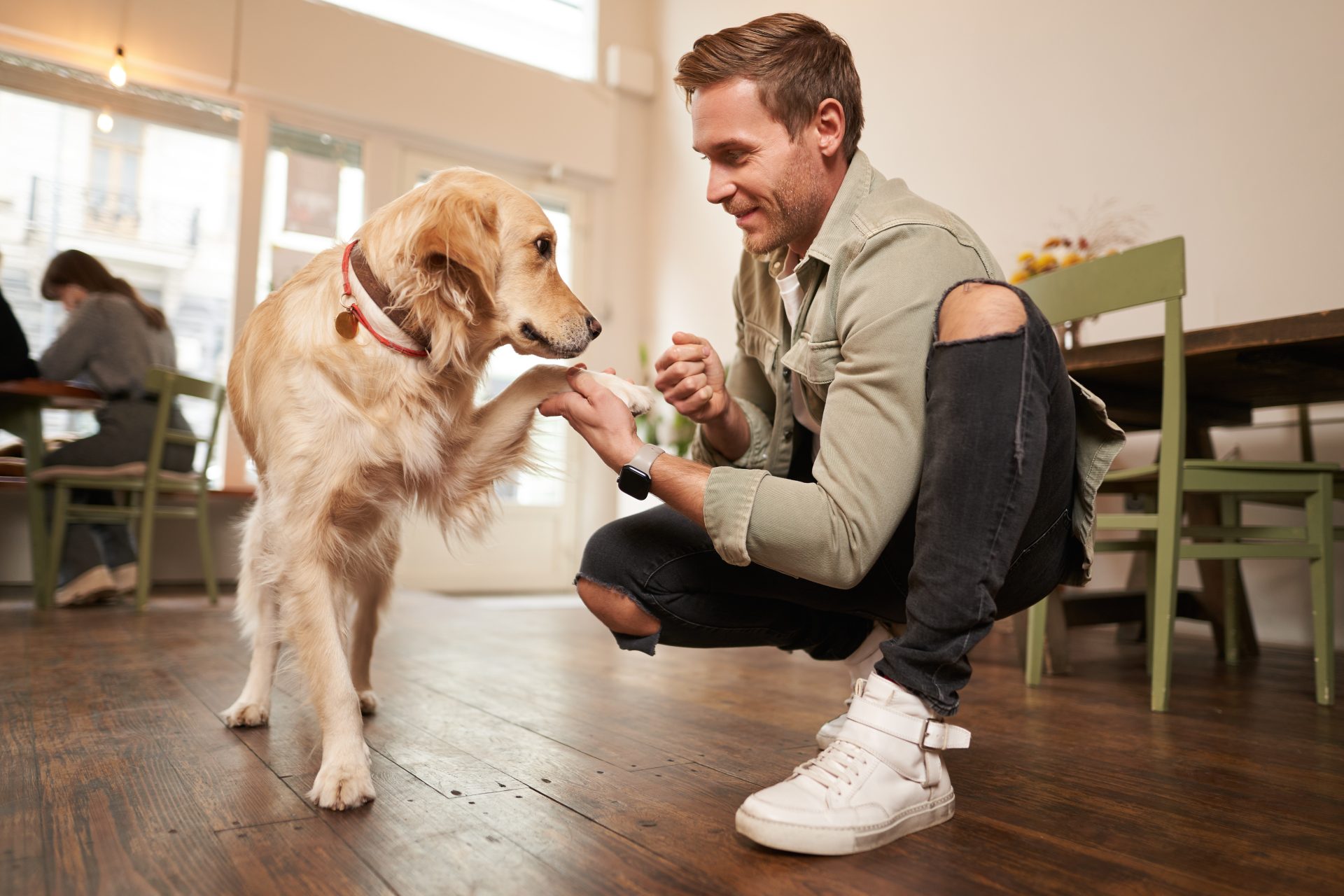
Dogs read people. They always have. Thousands of years of domestication have produced an animal whose survival has depended on understanding human emotional states — picking up on shifts in tone, body language, heart rate, breathing, and the dozens of other signals that humans broadcast continuously without realizing it.
Dog owners who love their dogs know this intuitively. They’ve seen the dog come close when they’re sad, get unsettled when an argument is happening, or react differently on a walk when their owner is anxious than when they’re calm. What most people don’t fully consider is what that attunement means for the dog’s behavior — and for the owner’s mental health.
How Dogs Experience Their Owner’s Emotional State
A dog’s sense of security is built around its owner. The owner provides food, safety, structure, and the emotional orientation that tells the dog how to interpret the world. When a person walks into a room relaxed and confident, the dog reads that signal and calibrates accordingly. When a person walks into a room tense, hypervigilant, or emotionally dysregulated, the dog reads that too — and often responds to it.
The mechanism isn’t complicated. Dogs don’t have access to the cognitive narratives humans use to process their experience — the explanations, the rationalizations, the ability to think their way through what they’re feeling. What they have is an exquisitely sensitive read on the emotional environment around them, communicated through every physical and behavioral signal the person in front of them is producing.
This is why a dog’s behavior is often a more accurate reflection of its owner’s emotional state than anything the owner might say about how they’re doing. The dog doesn’t have access to the performance of composure. It only has access to what’s actually happening.
What Anxiety, Depression, and Stress Look Like Through a Dog’s Eyes
The specific ways that an owner’s mental health affects their dog’s behavior depend on what the owner is experiencing and how the dog interprets it. Several patterns show up consistently:
- Anxiety in an owner signals to the dog that the environment contains threat. A dog who senses that its owner is anxious around other dogs or other people may begin to treat those things as threatening — reacting with barking, pulling, lunging, or avoidance that has more to do with the owner’s nervous system than with the dog’s own experience of the situation.
- Depression affects energy, engagement, and the quality of daily interaction. Dogs pick up on the flatness — the reduced walks, the less animated interaction, the absence of the emotional engagement that usually structures their day. A dog whose owner is significantly depressed may become lethargic, less responsive, or anxious in its own right as the emotional signal it’s reading changes.
- Chronic stress affects the physical signals an owner sends — tension in the body, changes in heart rate, a quality of distraction that the dog registers as absence even when the owner is physically present. A stressed owner who comes home from work carrying the residue of a difficult day brings that into every interaction with the dog, often without intending to.
- Trauma responses — hypervigilance, emotional reactivity, freeze states — communicate something specific to a dog that is constantly reading its owner for information about safety. A dog living with an owner whose nervous system is frequently in fight-or-flight is receiving a continuous signal that something in the environment requires alertness.
Each of these represents the dog doing exactly what dogs are built to do — reading its owner and responding to what it finds. The behavior that results isn’t the dog being difficult. It’s the dog being a dog.
“Our dogs need their owners to help them understand the world,” says Marc of Chicago Dog Trainer. “The more you take care of yourself, the more you’ll be able to take better care of your pet as well.”
The Regulation Connection
What dogs need from their owners, in behavioral terms, is co-regulation — the experience of being with a calm, grounded, emotionally stable presence that tells them the environment is safe and that their owner is in control of whatever needs to be managed. This is what good training builds toward. It’s also what mental health treatment supports.
A person who is managing significant anxiety has a nervous system that is running in a sustained state of activation — alert, scanning, reactive to signals that wouldn’t register the same way in a more settled state. That nervous system state is communicated to the dog continuously, regardless of what the person is doing or saying. The dog responds to the state, not the intention.
When therapy reduces the chronic activation — when anxiety treatment changes how the nervous system responds to perceived threat, when depression treatment restores engagement and energy, when trauma work reduces the hypervigilance that keeps a person in a persistent state of readiness — the signal the dog is reading changes. The owner is calmer. The dog, reading a calmer owner, becomes calmer too. The behavior that was a downstream effect of the owner’s emotional state often shifts without any direct intervention aimed at the dog.
The Owner’s Mental Health Is Part of the Training Environment
Dog trainers who work at a high level understand that training a dog means working with the owner as much as the dog. The dog is not operating in isolation — it’s operating within a relational environment, and the primary relationship in that environment is with its owner. Addressing behavior without addressing that environment produces limited results.
This is a principle that applies equally to human relationships. Couples therapy recognizes that a relationship’s difficulties can’t be addressed by working with only one partner in isolation. Family therapy recognizes that a child’s behavior exists within a family system that shapes it. The same logic applies to the owner-dog relationship — the dog’s behavior exists within an emotional environment that is largely determined by the owner’s mental health.
For dog owners who have tried training approaches that produced good results in certain contexts but didn’t hold up in others, the emotional environment is worth examining. A dog who performs well with a trainer and inconsistently with the owner at home is often telling you something about the difference between those two environments. The trainer’s calm, clear, regulated presence produces one result. The owner’s anxiety, stress, or emotional inconsistency produces another.
Why This Is a Reason to Seek Support
There are many reasons to address mental health, and most of them are personal — the quality of your own experience, your relationships, your capacity to be present in your own life. Sometimes those reasons feel abstract or insufficient to move someone to take action.
The connection to a dog’s wellbeing and behavior is more concrete for many people. A person who has delayed seeking therapy for anxiety because the reasons felt too internal or too uncertain may find more immediate motivation in the recognition that their dog is experiencing the anxiety alongside them — that the animal who depends on them most is reading their nervous system every day and calibrating its own sense of safety accordingly.
The dog wants its owner well. It wants the calm, grounded presence that tells it the world is safe. Therapy can help provide that — not just for the dog, but for the person whose life and relationships extend far beyond the end of the leash.
Flourish Psychology works with adults in Brooklyn and throughout New York City on anxiety, depression, trauma, and the full range of mental health concerns that affect daily life and every relationship in it. Call 917-737-9475 or reach out through the contact page to schedule a session.